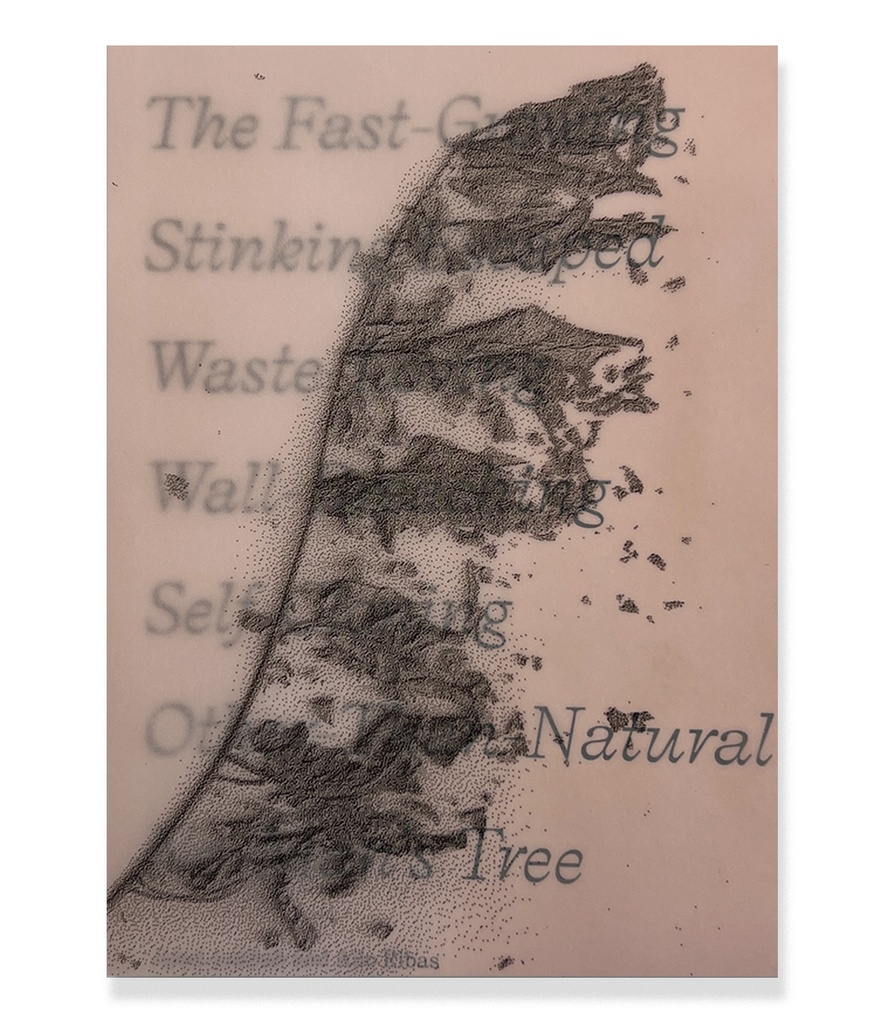
The fast-growing stinking escaped waste-loving wall-breaching self-cloning other-than-natural no-man’s tree
61.9 AEDThe fast-growing stinking escaped waste-loving wall-breaching self-cloning other-than-natural no-man’s tree
The fast-growing stinking escaped waste-loving wall-breaching self-cloning other-than-natural no-man’s tree
Artist book
Paperback
108 pages, 42 visuals
16.5 x 12 cm (4.7 x 6.5 in)
English and Arabic
Published by Sharjah Art Foundation
2024
ISBN 978-1-915656-22-3
The fast-growing stinking escaped waste-loving wall-breaching self-cloning other-than-natural no-man’s tree is a 4000-word bilingual English-Arabic photo essay examining the ecological, political and historical significance of ailanthus altissima (tree of heaven) in occupied Palestine. Introduced by the Jewish National Fund during its Jerusalem Forest afforestation projects from the 1960s to 1980s, this tree flourished across various urban fringes, roadside areas and seemingly abandoned land. Known for its pungent odour, which earned it the nicknames ‘tree of hell’ and the ‘stinking tree’, it is now classified by the Israeli Ministry for the Protection of the Environment as an invasive species.
Drawing on her formative experiences in Palestine and an interest in trees as political agents, Palestinian architect, artist and researcher Areej Ashhab provides a first-hand account of the invasiveness embodied by this unregulated, fast-growing weed-tree. The text is enriched by annotations by Catalan-British trans writer, researcher and community organiser Ailo Ribas, who unpacks the concepts of 'weediness' and explores issues of belonging and resistance within Palestine’s settler colonial context. Accompanied by recent photographs of the tree across Palestine, the publication lays bare the intricate root system and complex ecologies that underlie our geopolitical narratives.
This publication was realised through the support of Sharjah Art Foundation’s annual publishing grant (2023).